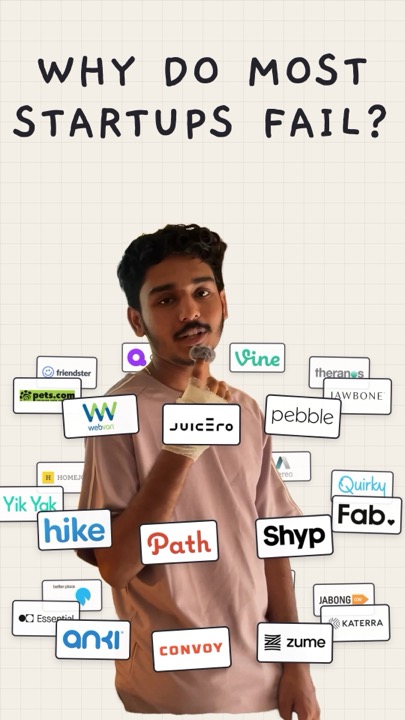
Why do most startups fail?
Most startups die.
Orbiting: 28 real startups that shut down. Webvan, Quibi, Juicero, Vine, Theranos, Pebble and more.
Most startups die. Some never find product-market fit. Some break up over co-founder fights. Some run out of money.
Pick the one you think kills the most.
It's you. That's the first page of The Book of Clarity by Paras Chopra. Most startups never die in the market. They die at the idea stage, inside the founder's head, before anyone else ever sees them.
The idea graveyard
Everyone has one. An idea you killed before you told anyone. Bury it here, then read what the book would say back.
Stays in your browser. Nothing is sent anywhere.
Four failures before the first win
Hindi for "soft-ware". It failed. So did the next three.
The day his own business earns what the job pays, he's out. His bar was ₹50,000 a month, the same as his salary.
That's the whole starting budget for Wingify.
Eighteen months later: a million dollars.

When does the side project beat the salary?
His rule was simple: the startup has to earn what the job pays. Drag the months and watch the coral line catch up.
Month 0. Nothing yet. This is where most ideas get killed.
Shape is illustrative. The real points: the target was ₹50,000 a month, and the first paying month brought in $4,000, so Wingify crossed the line in month one.
₹700 in. About $200 million out.
The 2025 deal valued Wingify at about $200 million, roughly ₹1,700 crore. Against the ₹700 he started with, that is about 2.4 crore times.
The number is fun. It isn't the point. The point is that a 15-year-old with four dead websites didn't stop at the idea stage. He kept shipping small things until one worked.
One idea a day, on camera
 ▶ Watch the reel
We met Paras at Lossfunk, where he spends his time now. I'm opening his book one idea at a time, one short video each, and writing up what I learn.
I build Ayu, a health records app for Indian families, and these ideas are the ones I keep coming back to while doing it.
- 8 OctWhy do most startups fail?
- 10 OctWhen should you start a startup?
- 11 OctWhy do businesses exist?
So, the idea you buried above?
Don't build it this week. Just tell three people about it today and see who asks a second question. That's the cheapest test there is, and it's the step most of us skip.